Free CV template

free cv template

Writing a CV can feel like a daunting task…

This is especially true if you’re not sure where to start, or your current one isn’t getting results. That’s where a free CV template can help. By using a ready-made structure, you can spend less time worrying about formatting, and more time making your skills and experience stand out.

We’ve already covered how to write a CV, but to help you increase your chances of success – we’ve put together a handy free CV template.


Please enter a valid email address

message here

By clicking Submit, you accept our Terms & Conditions and consent to receive emails and career related topics. See our Privacy policy for details. Continue without submitting


“Using a CV template gives you a head start by saving time on formatting, so you can focus on showing off your skills and achievements. It looks professional, keeps your layout consistent and helps you stand out from the start. That way, you spend less time worrying about design and more on what really matters – telling your story.”


Beth Green, Senior Executive Consultant | Reed


Why use a free CV template?

Starting with a blank page can be one of the hardest parts of writing a CV. That is, unless you have a template.

Here’s why it helps:

  • It saves time – You don’t have to create a layout from scratch
  • It looks professional – Everything’s already aligned and consistent
  • It’s ATS-friendly – Simple layouts are easier for Applicant Tracking Systems to read
  • It gives you a head start – You can focus on the content, rather than design

And because our template follows UK CV conventions, you don’t have to worry about the format being geared towards a US audience. No ‘resumes’ here. 

Should I use a template to write my CV?


What should a good CV template include?

Not all CV templates are created equal. To be effective, it should be:


✅ Clear and well structured

  • Easy to read, with plenty of white space
  • Standard headings like ‘Personal statement, ‘Work experience’ and ‘Education’
  • Consistent formatting for font sizes, bullet points and spacing

CV layout dos and dont’s


✅ Easy to tailor

  • A flexible layout that works across different industries
  • Sections you can easily adapt for different roles
  • Space to highlight your key skills and achievements

Tailoring your CV: What you need to know


✅ ATS-friendly

  • One-column layout (no sidebars or graphics)
  • Simple fonts (like Arial or Calibri, size 10–12)
  • No images, charts, or text boxes that could confuse screening software

CV templates and tips: The complete guide for jobseekers


recruiters looking at cv


How to use our CV template

Once you’ve downloaded the CV template, follow these steps to make it your own:


1. Add your personal details

Include your full name, phone number, email address and location (e.g. ‘based in London’). You don’t need to add your full address or a photo.


2. Write a personal statement

This is a short summary (around 4–6 lines) that highlights:

  • Who you are
  • What you can offer
  • What type of role you’re looking for

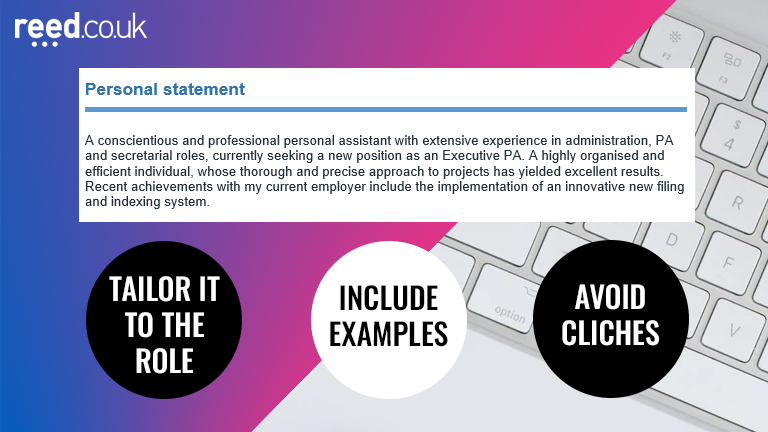
Example:

A conscientious and professional personal assistant with extensive experience in administration, PA and secretarial roles, currently seeking a new position as an Executive PA. A highly organised and efficient individual, whose thorough and precise approach to projects has yielded excellent results. Recent achievements with my current employer include the implementation of an innovative new filing and indexing system.

How to write a personal statement for job applications


3. Add your key skills

Pick 5–8 relevant skills that match the job description. These could include:

  • Software or tools (e.g. Excel, Adobe Photoshop)
  • Languages
  • Transferable skills (e.g. time management, teamwork)

You can use a bullet point list or a simple two-column layout. 

And if you’re missing the essential skills for the job you want? Consider upskilling. With a number of online and self-paced courses available, gaining a new skill doesn’t have to be time-consuming – and it could make all the difference when it comes to standing out to employers. 

Example:

  • 80 words per minute typing 
  • Proficiency in all areas of Microsoft Office, including Access, Excel, Word and PowerPoint
  • Excellent communication skills, both written and verbal 
  • Accredited member of APA (Association of Personal Assistants) 
  • Fully qualified first-aider 

Five CV skills employers look for in every jobseeker


4. List your work experience

Start with your most recent job and work backwards. For each role, include:

  • Job title
  • Employer name
  • Dates of employment (month and year)
  • A short summary of your responsibilities and achievements

Use bullet points and action verbs (e.g. delivered, improved, managed) to keep it clear.

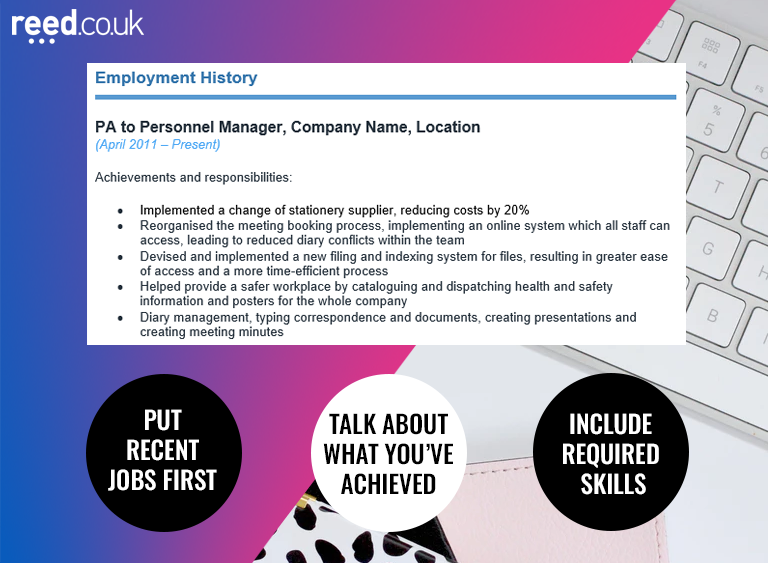
Example:

PA to Personnel Manager, Company Name, Location

(April 2024 – Present)

Achievements and responsibilities: 

  • Implemented a change of stationery supplier, reducing costs by 20%
  • Reorganised the meeting booking process, implementing an online system which all staff can access, leading to reduced diary conflicts within the team
  • Devised and implemented a new filing and indexing system for files, resulting in greater ease of access and a more time-efficient process
  • Helped provide a safer workplace by cataloguing and dispatching health and safety information and posters for the whole company 
  • Diary management, typing correspondence and documents, creating presentations and creating meeting minutes

How to: Get work experience

What to do when you have a long career history


5. Include your education

Again, list in reverse chronological order. Include:

  • Qualification name (e.g. BA (Hons) English Literature)
  • Institution
  • Dates
  • Any relevant modules or projects

If you’re a recent graduate or don’t have much work experience, place this section above your employment history.

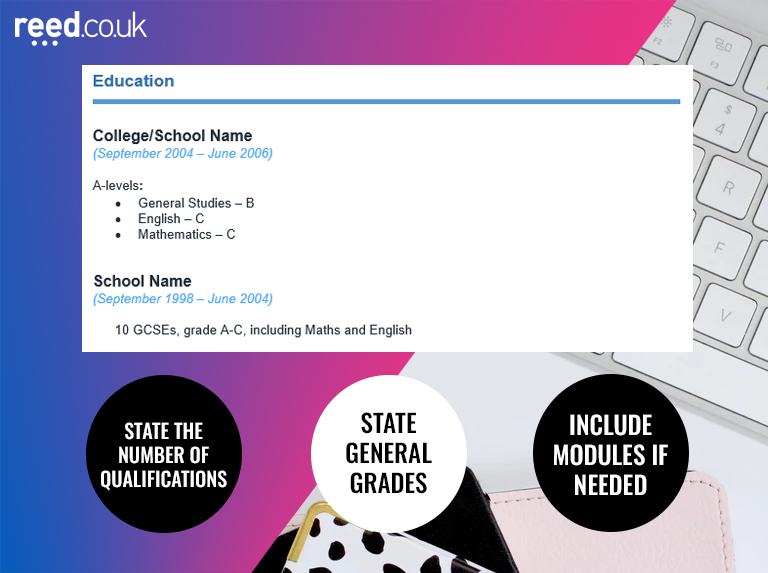
Example:

College/School Name

(September 2015 – June 2018)

A-levels:

  • General Studies – B
  • English – C
  • Mathematics – C

Which parts of my education should I include in my CV?

Should I go to university?


6. Include hobbies and interests (optional)

This section isn’t essential—but if you have space, it can give a more rounded picture of you, especially if you’re early in your career or have limited work experience.

Include 2–3 interests that:

  • Reflect positive traits (e.g. teamwork, creativity, dedication)
  • You’d be happy to discuss in an interview
  • Are relevant to the role or show transferable skills

Example:

I am involved in a local amateur dramatics society, where I volunteer as a lighting and sound technician. I have been involved with this society for three years and very much enjoy being part of the team. More recently, I assumed the role of Stage Manager for a two week production and relished the chance to take control of performances and react to a high-pressure environment. 

Avoid anything too generic (e.g. “socialising with friends” or “watching Netflix”).

Hobbies and interests: Should I include them in my CV?


7. Add references (or a note)

You don’t need to list full references on your CV. Most employers won’t contact them until later in the hiring process.

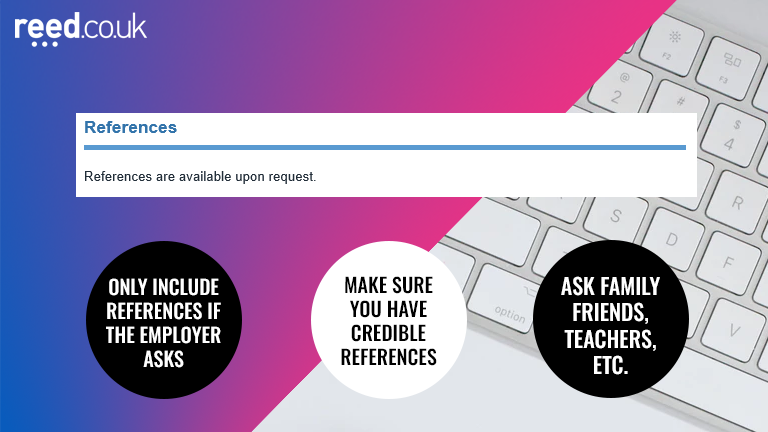
Instead, you can simply write:

References available on request

Or, if you’re short on space, leave this out entirely – it won’t count against you.

How to get a reference


person at desk writing notes with laptop


CV formatting tips

Before sending your CV, check the following:

  • Stick to 2 pages max (1 page if you’re early in your career)
  • Use a professional, easy-to-read font
  • Keep margins around 2.5 cm
  • Save your file as a .docx or PDF
  • Proofread carefully (spelling mistakes could cost you the job)

If you’re applying online, always check whether the employer has asked for a particular format (Word or PDF). Some online forms strip formatting from PDFs, so .docx can be a safer bet.


Common CV mistakes to avoid

Here are a few things to avoid in your CV:

MistakeWhy it’s a problem
❌ Spelling and grammar errorsGives a bad first impression (and goes against your ‘good attention to detail’ claim)
🎨 Using an over-designed layoutCan confuse ATSs, or look unprofessional
📜 Making it too longRecruiters often skim-read CVs, making conciseness essential
📚 Listing everything you’ve ever doneIrrelevant experience wastes space and diverts attention from what’s important
🤷 Being too vagueRecruiters look for real-life examples and practical evidence that prove you’re a match


Five lines that are killing your CV


Free CV templates for different jobs

Depending on your experience and the type of role you’re applying for, you might want to adjust the layout slightly. We have a range of templates and CV examples and samples to help:

View all CV templates


Final thoughts on CV format

Remember: this is a template, not a ready-made CV.

This means that it’ll only be effective if you actually put the work in. So before you get started – take some time to research the company and role, and think about how your skills and experience make you a good fit.

Then, do this for every single job you apply for. Because although you won’t have to completely rewrite your CV each time, making small changes that make it tailored to the job are essential.

Finally, your CV will always look different depending on your situation – whether you’ve just graduated, you’re coming back from a career break, you’re looking for part-time work, or anything else.

Take a look at our CV help & tips for specific pointers on how to write yours.


Ready to get started?

Please enter a valid email address

message here

By clicking Submit, you accept our Terms & Conditions and consent to receive emails and career related topics. See our Privacy policy for details. Continue without submitting

It’s formatted for UK jobs, easy to customise, and ready to use. 

Just add your details, tailor it to the role – and start applying.


Ready to put your CV to the test? View all available jobs now, or get qualified for a job you’ll love with a course