Electrical Engineering – Level 3 Training
Learningidol
Independent Online Learning • Updated 2026 Content • Transparent Pricing • Digital Certificate Included
Summary
- Reed Courses Certificate of Completion - Free
- Tutor is available to students
Add to basket or enquire
Overview
Certificates
Reed Courses Certificate of Completion
Digital certificate
- Show recruiters you've mastered in-demand skills
- Boost your CV and job applications instantly
- Share on LinkedIn to stand out from other candidates
- Transcript of completion included
Reed Courses Certificate of Completion
Digital certificate
- Show recruiters you've mastered in-demand skills
- Boost your CV and job applications instantly
- Share on LinkedIn to stand out from other candidates
- Transcript of completion included
Curriculum
This course contains
Format: 12 PDFs, 1 Article and 1 Quiz
Duration: 0h and 47m
Description
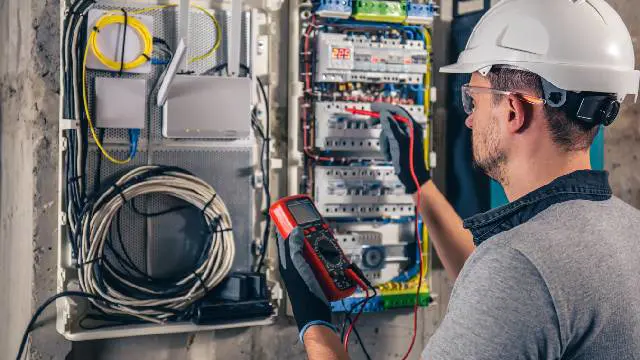
Electrical Engineering is a foundational discipline within modern engineering, supporting energy systems, industrial automation, electronics, telecommunications, and smart infrastructure. This Level 3 Training programme introduces learners to structured Electrical Engineering frameworks that underpin both traditional and emerging technologies.
The course begins with an overview of Electrical Engineering, examining the role of engineers in energy generation, distribution, automation, and system optimisation. Advanced circuit analysis modules explore voltage, current, resistance, impedance, and power calculations in AC and DC systems. Learners examine structured approaches to analysing complex circuits and understanding system behaviour.
Power systems analysis modules introduce generation principles, transmission networks, distribution frameworks, and load management. Emphasis is placed on system stability, efficiency, and protection mechanisms that ensure safe operation of national and industrial electrical grids.
Electronics modules examine semiconductor devices, diodes, transistors, amplifiers, and integrated circuits. Learners explore how electronic circuits are designed and analysed for signal processing and control applications. Digital electronics modules introduce logic gates, Boolean algebra, combinational circuits, and sequential systems.
Control systems modules focus on feedback loops, stability principles, and system response characteristics. Learners analyse how control mechanisms regulate electrical and mechanical systems in industrial and automated environments.
Electrical machines modules explore transformers, synchronous machines, induction motors, and DC machines. Emphasis is placed on operational principles, performance characteristics, and practical applications within power and industrial sectors.
Renewable energy modules introduce solar, wind, and alternative energy integration within modern power systems. Learners examine system compatibility, energy storage concepts, and sustainability considerations.
Advanced topics include power electronics, covering converters, inverters, and rectifiers used in energy conversion systems. High voltage engineering modules introduce insulation systems, transmission considerations, and safety frameworks. Emerging trends modules explore smart grids, electric vehicles, and energy-efficient technologies.
Throughout the programme, Electrical Engineering is presented as a structured technical discipline grounded in mathematical modelling, system safety, and technological innovation. The final examination evaluates comprehension of circuit analysis, machine operation principles, and system integration frameworks.
Who is this course for?
This programme is suitable for:
Aspiring electrical engineers
Engineering students seeking foundational Electrical Engineering knowledge
Technicians expanding theoretical understanding
Individuals exploring renewable energy systems
Professionals preparing for further accredited engineering study
The course is ideal for learners seeking structured theoretical understanding of Electrical Engineering principles without pursuing regulated engineering registration or installation certification.
Requirements
There are no formal entry qualifications required for enrolment. Basic mathematics knowledge and an interest in engineering or technology will support engagement with Electrical Engineering concepts. Learners should have access to a computer or tablet with reliable internet connectivity. Commitment to completing course materials and the final online examination is necessary to demonstrate theoretical understanding.
Career path
Knowledge of Electrical Engineering principles may support progression into engineering technician roles, renewable energy support positions, industrial maintenance environments, or further accredited engineering qualifications. This course strengthens theoretical foundations rather than conferring professional engineering registration or installation licence status.
Questions and answers
There are currently no Q&As for this course. Be the first to ask a question.
Reviews
Add to basket or enquire
Course provided by


Legal information
This course is advertised on Reed.co.uk by the Course Provider, whose terms and conditions apply. Purchases are made directly from the Course Provider, and as such, content and materials are supplied by the Course Provider directly. Reed is acting as agent and not reseller in relation to this course. Reed's only responsibility is to facilitate your payment for the course. It is your responsibility to review and agree to the Course Provider's terms and conditions and satisfy yourself as to the suitability of the course you intend to purchase. Reed will not have any responsibility for the content of the course and/or associated materials.
