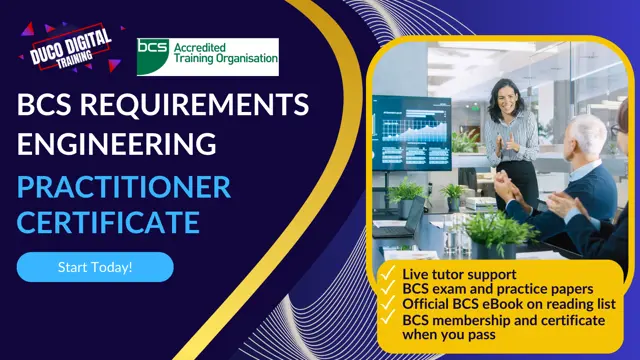
BCS Practitioner Requirements Engineering
Duco Digital
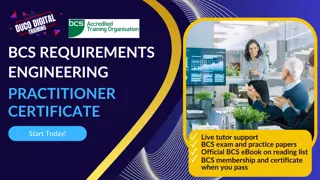
BCS Book, BCS Exam and Live Instructor Support Calls Included
Summary
- BCS Professional Certificate - Free
- Duco Digital Training certificate of completion - Free
- BCS exam (included in price)
- Tutor is available to students
Add to basket or enquire
Overview
Certification
BCS Practitioner Certificate in Requirements Engineering

Certificates
BCS Professional Certificate
Digital certificate - Included
When you pass the exam, you will receive a digital BCS professional certification which you can add to your LinkedIn profile and CV. And if you’re a new BCS member, when you pass the exam, you will also receive 1 free year BCS Associate membership for professional networking, continue your learning and career support.
Duco Digital Training certificate of completion
Digital certificate - Included
In addition to the BCS professional certificate, when you complete the course, you will also receive a Duco Digital Training certificate of completion which you can add to your LinkedIn profile and CV - you do not need to pass the exam to gain this. If you have any questions, please contact us.
Assessment details
BCS exam
Included in course price
We include the cost of one BCS exam attempt in your course. The exam is multiple choice and full details and instructions are in the course. We also provide sample question papers, exam tips videos and short meetings with a tutor for you to ask questions. If you have any questions about the exam, please contact us.
Course media


Description
The BCS Practitioner Certificate in Requirements Engineering is a globally recognised professional qualification which will help develop your knowledge and understanding in these specific subjects:
1. Define Requirements Approach and Project Scope:
- Define the term “Requirements”
- Describe the Requirements Engineering Framework
- Explain factors to be considered in adapting the approach to requirements engineering
- Describe the contents of a project initiation document (PID)/terms of reference (ToR)
2. Elicit Requirements:
- Explain different knowledge types
- Identify a technique to articulate tacit knowledge
- Explain the use, advantages and disadvantages of the following elicitation techniques
- Identify an appropriate technique to elicit requirements
- Explain the suitability of elicitation techniques for Agile and linear development approaches
3. Record Requirements (Documentation):
- Identify and describe the categories of requirement
- Explain the importance of documentation
- Identify the key documentation styles
- Explain the characteristics documented for requirements in a requirements catalogue
- Explain the key underlying principles and standard format of a user story
4. Build Models and Prototypes to Represent the Requirements:
- Explain the rationale for modelling the functional requirements (processing and data) of an
information system - Describe the purpose of modelling in requirements engineering
- Prepare a UML use case diagram
- Prepare a UML Class diagram
- Explain the use of a CRUD matrix
- Explain the use of prototyping to elaborate requirements
5. Collaborate and Communicate with Stakeholders to Clarify Requirements:
- Describe the responsibilities of the actors (stakeholder roles) in Requirements Engineering
- Describe the purpose of requirements validation
- Describe the rationale for various approaches to requirements validation
- Demonstrate how Agile requirements are validated
- Demonstrate how formal requirements are validated
6. Analyse, Prioritise and Assure the Quality of Requirements:
- Explain the purpose of analysing requirements
- Apply the MoSCoW technique to prioritise requirements
- Interpret individual requirements; applying filters and quality criteria
- Identify the purposes of Slicing Requirements (Agile/ Linear)
- Identify techniques used to analyse Business Rules
- Explain the importance of testability
7. Conduct User analysis and Profiling:
- Describe techniques used to analyse roles
- Explain the purpose of a Customer Journey Map
8. Requirements Management and Traceability:
- Explain the rationale and the approach to achieving requirements traceability
- Explain the rationale for requirements management
- Define the elements of requirements management and the links between them
- Explain the use of a change control process
- Describe the elements of a version control process
- Explain the use and advantages of different forms of traceability
Exam Information of BCS Practitioner Certificate in Requirements Engineering:
- It is a multiple-choice exam
- Pass mark is 26/40 points or 65%
- Duration of the exam is 60 minutes
- The exam will be supervised virtually.
Who is BCS?
Recognised globally by corporations, academics and IT professionals, BCS is the British Computer Society, more commonly known as the Chartered Institute for IT.
They have over 60,000 members in 150 countries, and a wider community of business leaders, educators, practitioners and policy-makers all committed to their mission of leading the IT industry through its ethical challenges, to support the people who work in the industry, and to make IT good for society.
What our students say about us:
"The training provided will assist me to conduct AI research projects in a more professional and systematic way. The knowledge provided will be incredibly valuable for my future study in the field of computer vision." — Muhammad Lecturer and AI PhD Candidate
“Good training materials for remote learning, and the most impressive part was the speed at which they responded to questions.” — Tom Data Protection Practitioner
"This proved to be a very valuable course to me." — Janet Business Analyst
Supporting new and the next-generation of analysts
Soni is passionate about the value and importance of business analysis in bridging the gap between business and technology and is excited to champion and support new and next-generation analysts like you.
She has over 20 years’ experience as a business analyst complimented with a MEng degree in Computer Science. In addition, she has experience of project management, enterprise architecture and agile project delivery. Her career as a senior business analyst has involved delivering large digital transformation programmes for both government and corporate organisations in a variety of sectors such as Defence, Banking, Cyber Security, Telecommunications, and IT.
If you have any questions about choosing the right course for your career, please contact us.
Who is this course for?
Who is this course for?
Whether you're a seasoned professional looking to refine your skill set or someone embarking on a new career path, the BCS Practitioner Certificate in Requirements Engineering is designed for you. It's perfect for:
- Aspiring Business Analysts: Individuals eager to break into the dynamic world of business analysis and carve out a rewarding career.
- IT and Computing Students: University students seeking to supplement their academic knowledge with practical, industry-relevant skills.
- Career Changers: Those considering a transition into business analysis from diverse backgrounds, eager to leverage their existing expertise in new ways.
- Process Improvement Enthusiasts: Professionals focused on streamlining operations and enhancing efficiencies within organizations.
- Project Managers and Executives: Mid-level managers, senior leaders, and directors aiming to bolster their analytical prowess and drive strategic decision-making.
Specifically, the following roles could benefit from this course (as well as good examples of career opportunities):
- Business Analyst
- Business Architect
- Business Systems Analyst
- Data Analyst
- Enterprise Analyst
- Management Consultant
- Process Analyst
- Product Manager
- Product Owner
- Project Manager
- and Systems Analyst.
Requirements
- None—no experience or qualifications are needed, although if you have no experience in business analysis, you should read the BCS Business Analysis ebooks that we send you and consult the reading list or consider taking the BCS Business Analysis Foundation course first as that covers essential concepts in detail.
- We recommend beginners to consult the reading list and explore recent news and case studies using modelling business processes in the sector they work in.
- An internet connection with a mobile/tablet or laptop is required.
Career path
According to the 2023 Salary Guide by Robert Half, the median salary for a business analyst in the U.S. was $95,520.
However, individuals with advanced skills, such as proficiency in business intelligence software or an understanding of data analytics, could earn even more. This demonstrates the potential financial benefits of investing in business analysis training.
Questions and answers
Currently there are no Q&As for this course. Be the first to ask a question.
Reviews
Currently there are no reviews for this course. Be the first to leave a review.
Add to basket or enquire
Course provided by


Legal information
This course is advertised on Reed.co.uk by the Course Provider, whose terms and conditions apply. Purchases are made directly from the Course Provider, and as such, content and materials are supplied by the Course Provider directly. Reed is acting as agent and not reseller in relation to this course. Reed's only responsibility is to facilitate your payment for the course. It is your responsibility to review and agree to the Course Provider's terms and conditions and satisfy yourself as to the suitability of the course you intend to purchase. Reed will not have any responsibility for the content of the course and/or associated materials.